
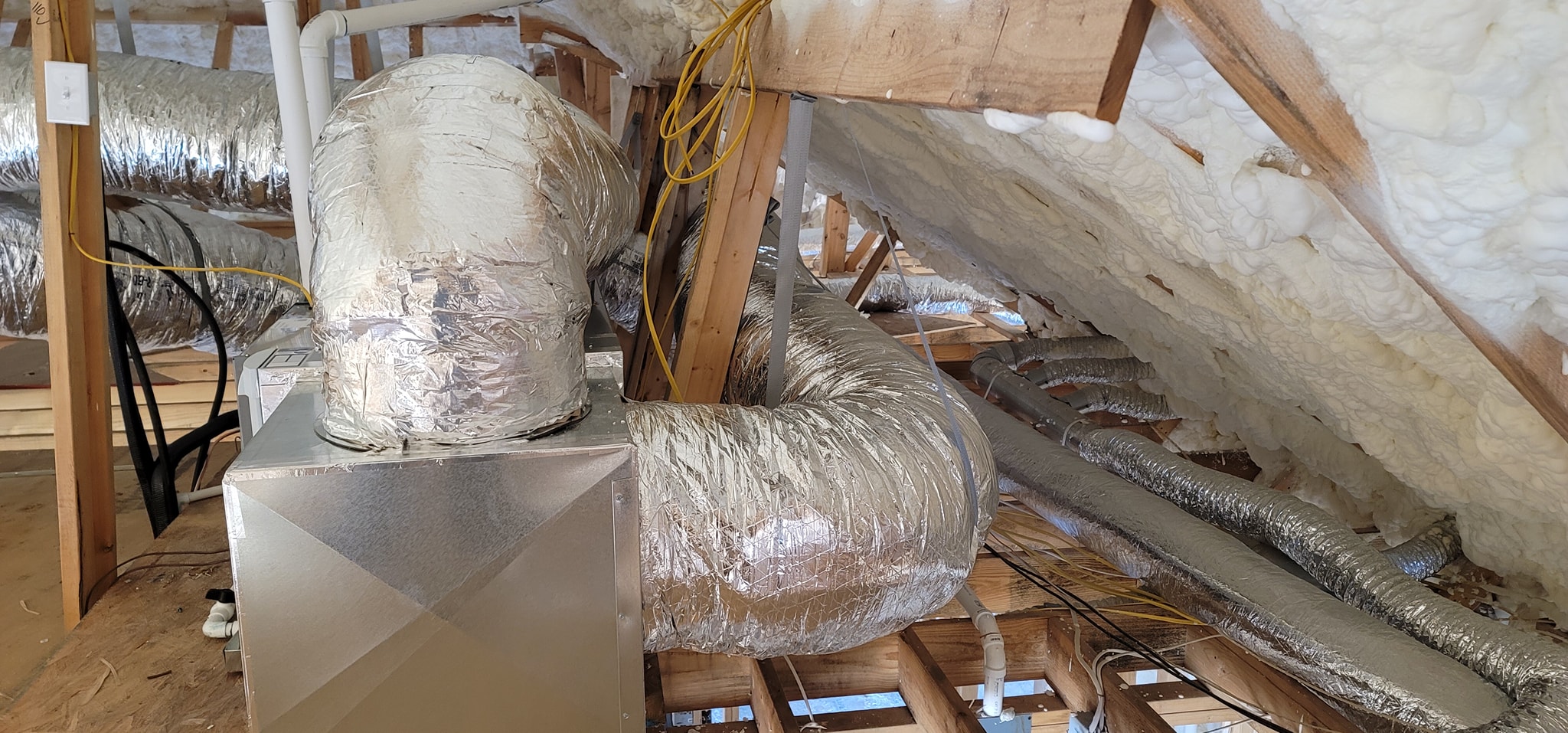
You're building a new foam-insulated house, or the HVAC in your foam house is on its last leg. Every contractor is quoting different tonnage. Here's how to make sure you don't buy 2x more AC than you need.
You probably came here because…
- You're getting HVAC quotes for a foam-insulated home
- Contractors are quoting 3-, 4-, or 5-ton systems for a 2,500–3,500 sqft home
- None of them mention Manual J or ask about window orientation, glazing, or air infiltration
- You suspect the sizes are too big (or someone told you 'go smaller')
What’s actually happening
Rule-of-thumb HVAC sizing uses square footage divided by a fixed number (like 500 sqft per ton). That was calibrated on fiberglass-insulated 1990s tract homes. It doesn't apply to a modern foam-insulated envelope.
A real foam house typically needs 30–50% less cooling capacity than a fiberglass house of the same square footage. So the 4-ton AC a contractor is quoting for your 3,000 sqft foam home is probably really a 2- or 2.5-ton house.
The only way to know is a Manual J load calculation. It's a room-by-room analysis that accounts for insulation R-values, window U-values and orientation, ceiling height, occupancy, appliances, and infiltration. It takes about 2 hours of engineering work. Most contractors skip it because it costs them money and might shrink the sale.
What we do about it
Ask every bidder for a written Manual J
Not a rule-of-thumb estimate. A real Manual J with room-by-room load numbers. If a contractor won't provide one, cross them off the list. This one filter cuts your bidder pool by 80%.
Have them justify the equipment size
If the Manual J shows 24,000 BTU cooling load and they're quoting a 3-ton (36,000 BTU) system, ask why. The answer 'safety margin' means they're padding. A well-sized system should be within 10% of the calculated load.
Ask about variable-speed
In a foam house, a variable-speed system that modulates down to 30% of capacity handles low-load situations far better than a fixed-speed 2-ton. Costs $1,500–3,000 more upfront but saves that back in comfort and humidity control.
Plan for dehumidification
Even a properly-sized system may need help with humidity in a foam house. Ask the contractor if they'll spec a whole-house dehumidifier if the load numbers suggest it. If they don't know what that means, next bidder.
The bigger-is-safer myth
Some contractors will insist on going up a size 'just in case.' In a foam house, oversizing is not safety margin. It's guaranteed humidity problems, short cycles, and a system that dies earlier from constant on-off cycling. If a contractor won't run a Manual J, they're guessing with your money. Call (423) 637-1846 — we'll run the numbers.
Ready to fix it?
Call the family that’s been doing this in the Sequatchie Valley since 1996.