
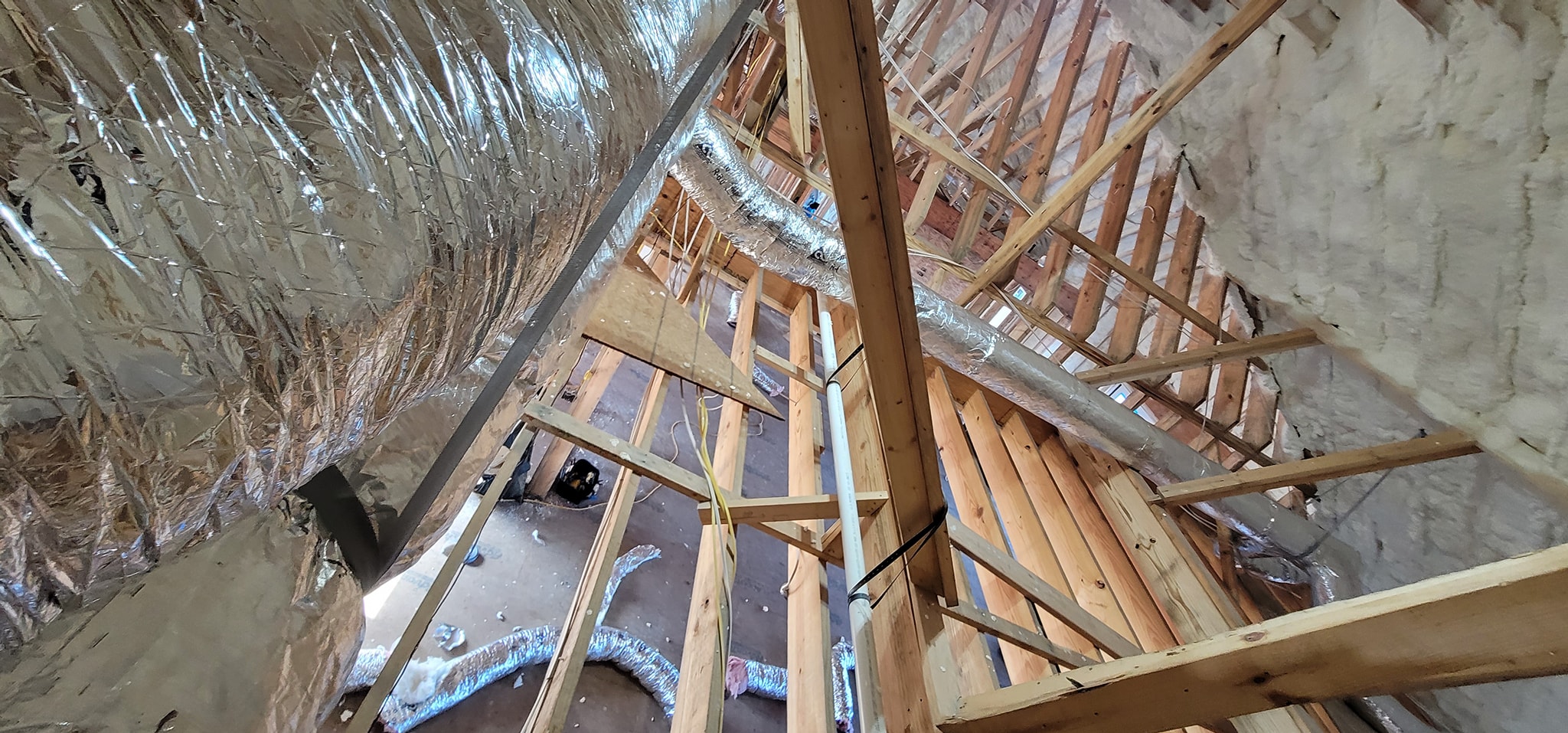
Your foam-insulated house has a bedroom that's 78 when the thermostat says 72. Or an upstairs bonus room that's a sauna. This is a foam-house-specific problem, and the answer is almost always zoning.
You probably came here because…
- Spray-foam-insulated home, built or retrofitted in the last 15 years
- One or two rooms are consistently 5–10 degrees off from the thermostat
- The problem is worse on hot afternoons or cold nights
- Adjusting registers doesn't fix it
- Sun-facing rooms cook; north-facing rooms freeze
What’s actually happening
Foam insulation reduces heat transfer through walls dramatically — but it doesn't change solar gain through windows or the internal load from bodies, appliances, and electronics. So a foam house's biggest temperature drivers are windows and occupancy, not envelope leakage.
That means the hot room isn't hot because heat is coming through the walls. It's hot because sunlight is streaming through the windows and there's nowhere for that heat to escape. In a fiberglass house, some of that heat would leak out through the walls. Foam traps it in the room.
The fix is almost always zoning — either a proper multi-zone ductwork system with dampers and a smart controller, or a ductless mini-split for the problem room. Adding more central AC capacity makes it worse: the rest of the house gets colder while the sun-baked room stays hot.
What we do about it
Log the pattern
For a week, note which rooms are hot or cold, at what time of day, and in what weather. Sun-facing rooms hot in afternoon = solar gain. All-day hot rooms = internal loads (kitchen, media room). Cold rooms all day = poor duct delivery.
Rule out register or duct issues first
Open every register fully. Check for a crushed duct or a closed damper in the attic or crawlspace. In foam houses with ducts in unconditioned space, insulation on the ducts may be inadequate — that's easier to fix than adding zones.
Add a mini-split for the worst room
A single 9,000 or 12,000 BTU ductless mini-split in the problem room is typically $3,500–5,000 installed. It solves the problem without touching the central system. Great when only one or two rooms are affected.
Or convert to zoned ductwork
For a whole-house solution, we can retrofit dampers and a zone controller into the existing ductwork. Usually 2–4 zones for a typical foam house. Runs $4,000–8,000 depending on system complexity. Best long-term answer.
Don't just install a bigger AC
The most common bad advice for uneven foam houses: upsize the central system. That makes short-cycling worse, humidity worse, and comfort worse in every room except maybe the problem room. Call (423) 637-1846 and we'll run the numbers before recommending anything.
Ready to fix it?
Call the family that’s been doing this in the Sequatchie Valley since 1996.