
Your foam house is at 72 degrees but feels like a swamp. Windows sweat. Wood floors cup. Musty smell in closets. Your AC is running — cooling the air but not drying it. Very foam-house-specific problem.
You probably came here because…
- Spray-foam-insulated home
- Indoor humidity above 60% in summer, sometimes 65–70%
- AC keeps the house cool but it still feels sticky
- Condensation on windows, cold-water pipes, or return grilles
- Musty smell in closets, basements, or crawlspaces
What’s actually happening
Your AC does two jobs: cool the air and remove moisture. Moisture removal only happens when the coil runs long enough for water to condense out. In a foam house, the cooling load is so low that the AC only runs 3–5 minutes at a time — not long enough to pull much water out.
So you end up with a house that hits the temperature target but never dries out. Every time you open a door, cook, shower, or breathe, you're adding moisture that the AC can't remove.
There are two real fixes: 1) replace the oversized AC with a properly-sized variable-speed system that can run longer at low capacity, or 2) add a dedicated whole-house dehumidifier. The dehumidifier is almost always faster and cheaper.
What we do about it
Get a real humidity reading
A $15 hygrometer from Amazon. Put it in your main living area. Take readings for a week. Anything above 55% in summer is a comfort problem. Above 60% is a moisture-damage problem.
Check AC runtime
Sit and watch the AC. How long does it run before shutting off? If it's 3–5 minutes then quiet for 15 minutes, the system is way oversized for a foam house. That's your root cause.
Consider a whole-house dehumidifier
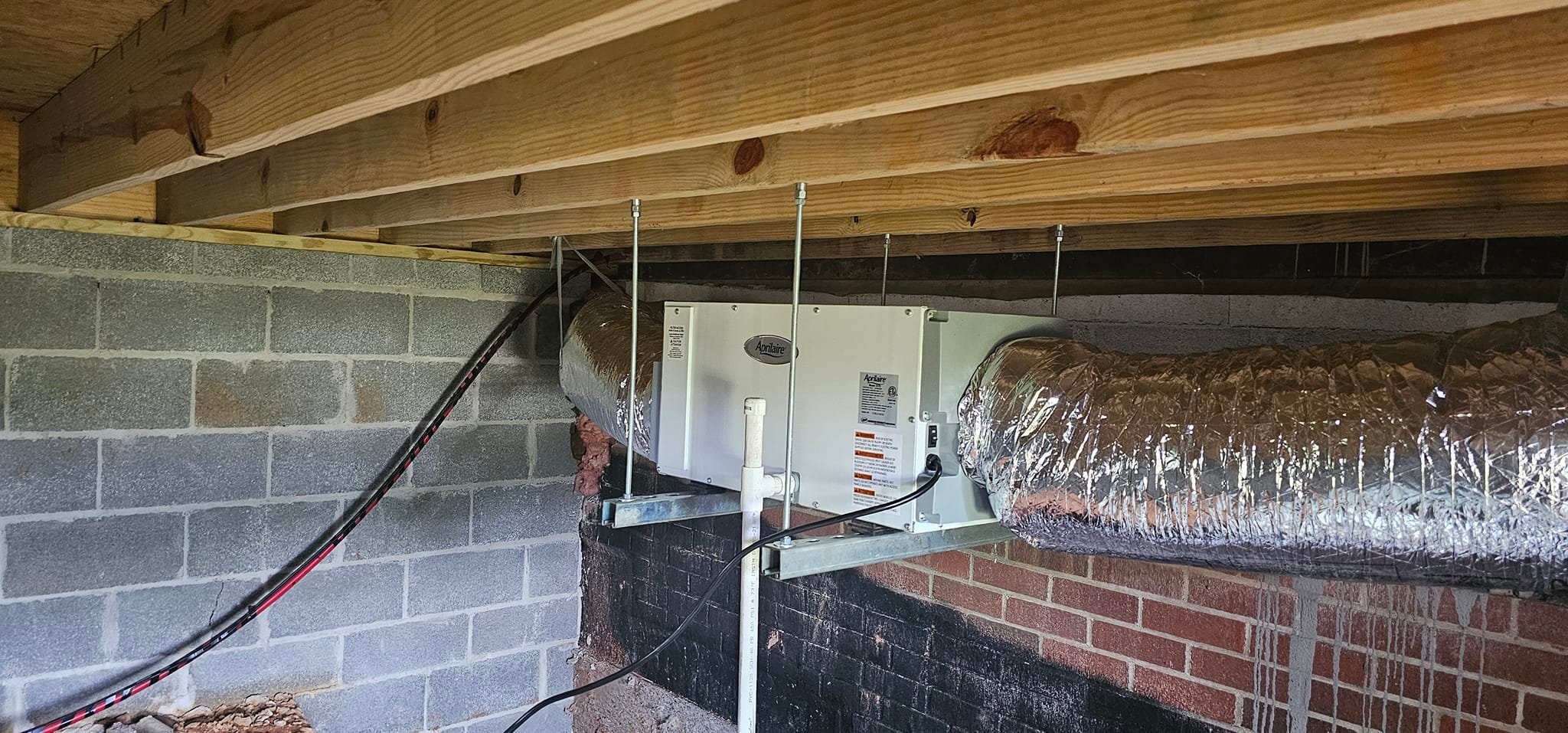
Aprilaire or Ultra-Aire whole-house dehumidifier ties into your return ductwork. Runs whenever humidity exceeds setpoint, independent of the AC. About $2,500–3,500 installed. Solves the problem in one afternoon. Best cost/benefit fix we know for a foam house.
Long-term: right-size the AC
When it's time to replace the AC anyway, drop to a properly-sized variable-speed system based on a Manual J load calc. Longer runtimes automatically fix the humidity issue. But don't rip out a working AC just for this — a dehumidifier is a fraction of the cost.
Humidity above 60% causes real damage
Sustained high indoor humidity ruins hardwood floors, grows mold behind drywall, and rusts electronics. Foam houses with humidity problems can develop mold in wall cavities that stays hidden for years. If your foam house is chronically above 60%, don't wait. Call (423) 637-1846.
Ready to fix it?
Call the family that’s been doing this in the Sequatchie Valley since 1996.